
PodcastCrew Editorial Team
July 31, 2026 · 14 min read
The ROI of Professional Training Videos: How Businesses Reduce Costs and Improve Employee Performance
Discover how professionally produced training videos reduce onboarding costs, improve employee performance, increase knowledge retention, and create long-term business value that extends far beyond a single training session.

Many businesses think of training videos as an expense. The smartest businesses treat them as an investment.
A professionally produced training video can reduce onboarding time, improve employee performance, decrease repetitive training costs, reduce compliance errors, and create a consistent training experience across your entire organization.
At PodcastCrew, we've worked with businesses that spend the same amount of time answering the same questions every week. In many cases, a well-planned training video library becomes one of the highest-return content investments a company can make.
The ROI of training videos is not just about saving time. It's about improving consistency, scalability, and operational efficiency.
In this guide, we'll break down the real return on investment of professional training videos, how businesses calculate ROI, and why professionally produced training content often pays for itself faster than companies expect.
Why Training Videos Have Become a Business Necessity
The modern workplace has changed. Companies are onboarding remote employees, training multiple locations, updating processes more frequently, and managing increasingly complex compliance requirements.
Traditional training methods often create problems such as inconsistent instruction, long onboarding timelines, knowledge gaps, high training costs, repeated interruptions for managers, poor documentation, and employee frustration.
Professional training videos solve these problems by creating a repeatable, scalable training system. Instead of delivering the same training repeatedly, businesses can deliver the same high-quality training every time.
What Are Professional Training Videos?
Professional training videos are structured educational videos designed to improve employee knowledge, performance, and consistency.
Common examples include employee onboarding videos, safety training videos, compliance training, software training, customer service training, equipment operation videos, leadership training, process documentation, standard operating procedure (SOP) videos, and internal knowledge libraries.
Unlike informal screen recordings or smartphone videos, professionally produced training videos are designed for clarity, retention, engagement, and long-term usability.

The Biggest Misconception About Training Video ROI
Many businesses compare the cost of a training video to the cost of creating the video. They should compare it to the cost of repeated training.
For example: a manager spends 3 hours onboarding each new employee. The company hires 30 employees per year. That equals 90 hours of manager time annually. If that manager's time is worth $75 per hour, onboarding alone costs $6,750 per year.
A professional onboarding video that reduces onboarding time by 50% could save $3,375 annually. And that's only one training process.
The 5 Biggest Financial Benefits of Professional Training Videos
1. Reduced Onboarding Costs
Onboarding is one of the most expensive training activities in most organizations. Training videos reduce costs by standardizing instruction, reducing manager involvement, eliminating repetitive explanations, allowing self-paced learning, and accelerating employee readiness. New employees become productive faster.
2. Increased Employee Productivity
Well-trained employees make fewer mistakes. Training videos improve productivity by creating clear expectations, consistent procedures, better process understanding, faster skill development, and easier access to information. Employees spend less time asking basic questions and more time doing productive work.
3. Improved Knowledge Retention
People rarely remember everything from a live training session. Training videos allow employees to rewatch information, learn at their own pace, review procedures when needed, and reinforce learning over time. This dramatically improves knowledge retention compared to one-time verbal training.
4. Consistent Training Across Locations
Businesses with multiple locations often struggle with inconsistent training. Professional training videos ensure that every employee receives the same instruction regardless of location, manager, department, shift, or hiring date. Consistency reduces operational variation and improves quality control.
5. Reduced Compliance and Safety Risk
For regulated industries, inconsistent training creates liability. Training videos provide documented, standardized instruction for safety procedures, compliance requirements, equipment operation, documentation processes, and regulatory updates. This can reduce both financial and legal risk.
How Businesses Calculate Training Video ROI
A simple ROI calculation includes four factors:
Training time saved — How many hours are eliminated from repeated training?
Labor cost savings — What is the hourly cost of managers, trainers, or specialists conducting training?
Error reduction — How much do mistakes, rework, or compliance issues currently cost?
Productivity improvement — How much faster do employees become fully productive?
For many organizations, the payback period is surprisingly short.

Example ROI Calculation
Assume a business invests $8,000 in professional onboarding and process training videos.
Current training costs: 120 training hours annually at a manager rate of $60/hour, for an annual training labor cost of $7,200.
If training videos reduce training time by 60%, the company saves 72 hours annually — $4,320 per year. The videos would recover more than half their cost in the first year. In the second year, they continue generating savings.
And that calculation still excludes reduced errors, faster onboarding, better retention, and improved consistency.
Why Professionally Produced Training Videos Outperform DIY Videos
Many companies create internal training videos using webcams or screen recordings. For some situations, that is sufficient. However, businesses often underestimate the cost of poor training content.
Employees disengage quickly when videos have poor audio, confusing structure, weak visuals, inconsistent messaging, outdated branding, or difficult navigation. Professional production improves both engagement and retention.
What Makes a Training Video Effective?
At PodcastCrew, effective training videos usually share four characteristics.
Clear learning objectives — Employees should know exactly what they will learn.
Logical structure — Information should be organized into clear, manageable sections.
Visual demonstration — People learn faster when they can see the process.
Easy accessibility — Training videos should be easy to find and easy to revisit.
The Ideal Training Video Length
Long training videos often reduce completion rates. A better approach is modular training.
General guidelines: quick process videos 2–5 minutes, software tutorials 3–7 minutes, SOP demonstrations 5–10 minutes, safety training modules 5–15 minutes, and comprehensive onboarding delivered as a series of multiple short videos.
Shorter videos improve completion and make updates easier.
The Hidden Value of a Training Video Library
One training video is useful. A training video library is transformational.
A complete internal knowledge library can include department training, software tutorials, customer service standards, sales training, equipment procedures, HR policies, leadership development, and compliance updates. Over time, this becomes a searchable operational asset.
Industries That See the Highest ROI
Professional training videos are especially valuable for healthcare, manufacturing, construction, commercial services, technology companies, financial services, hospitality, retail, logistics, and professional services.
These industries often have complex processes, compliance requirements, or high employee turnover.
The Production Process Matters
The ROI of a training video is heavily influenced by how it is produced. A professional process typically includes:
Training analysis — Identify the processes creating the biggest operational costs.
Content planning — Organize information into clear learning modules.
Script development — Ensure accuracy, clarity, and consistency.
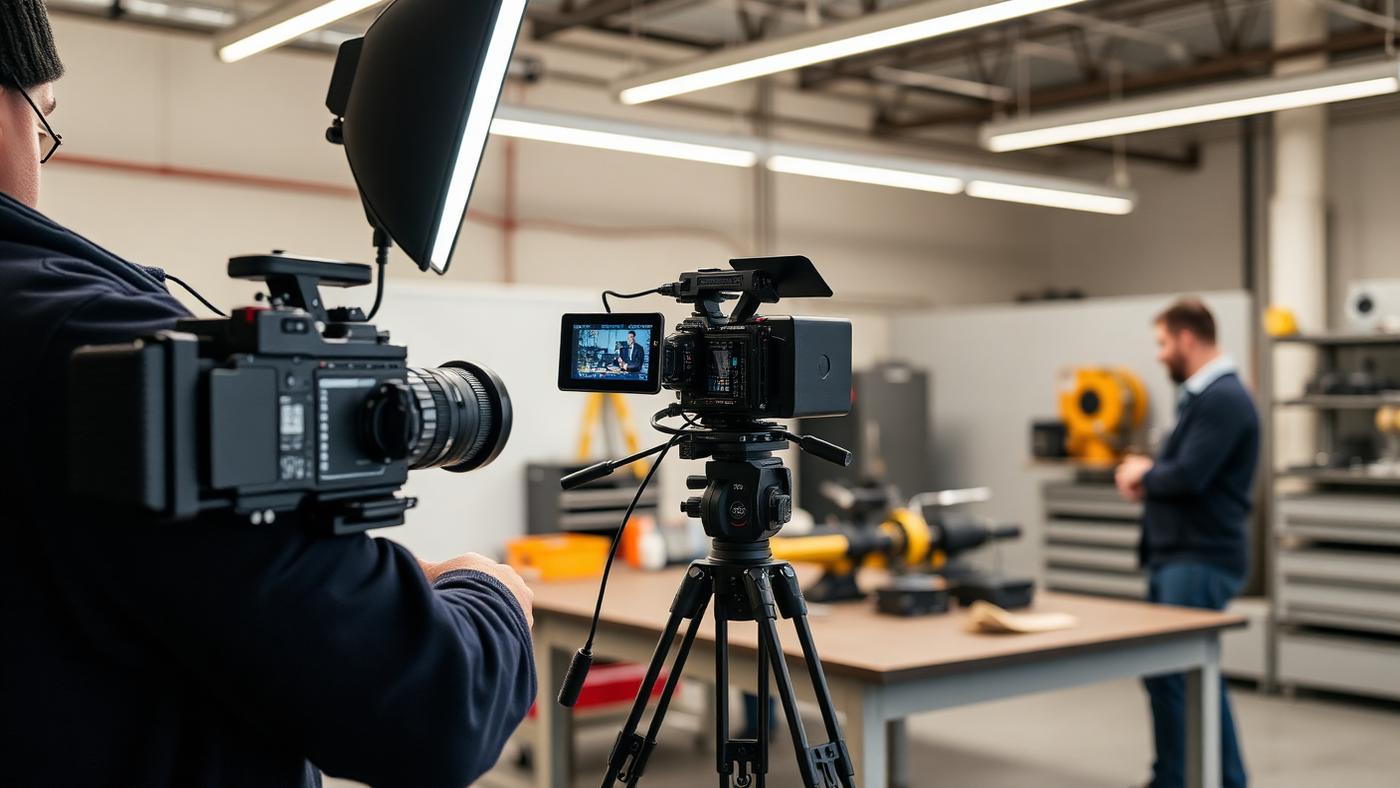
Professional filming — Capture demonstrations clearly and professionally.
Editing and graphics — Improve understanding with visuals, text, and motion graphics.
Distribution planning — Ensure employees can easily access the training.
Common Training Video Mistakes
Trying to cover everything in one video. Break complex topics into modules.
Focusing on information instead of application. Show employees exactly what to do.
Using poor audio. Audio clarity is critical for learning.
Failing to update content. Training videos should evolve with your processes.
Not measuring results. Track completion, retention, and performance improvements.
Measuring Training Video Success
Important metrics include onboarding time, training completion rates, knowledge assessment scores, employee productivity, error rates, compliance incidents, support requests, manager training time, and employee retention.
The best training videos improve measurable business outcomes.
Training Videos and Company Culture
Training videos do more than teach processes. They communicate standards.
Professional training videos reinforce company values, customer service expectations, safety culture, leadership philosophy, communication standards, and brand consistency. This creates a more aligned organization.
Why Businesses Choose a Professional Video Production Company
The difference between a video that employees tolerate and a video they actually learn from is often production quality and instructional design.
A professional production company brings strategic planning, instructional structure, professional filming, clear audio, visual storytelling, editing expertise, motion graphics, and long-term scalability. The result is a training system, not just a video.
Final Thoughts
Professional training videos are not just educational content. They are operational infrastructure.
They reduce costs, improve employee performance, increase consistency, strengthen compliance, and create knowledge assets that continue generating value year after year.
For many businesses, the question is not whether training videos are worth the investment. The question is how much repeated training, inconsistency, and lost productivity are already costing the organization.
At PodcastCrew, we help businesses create professional training videos that improve onboarding, strengthen employee performance, and deliver measurable ROI across teams, locations, and departments.
When training becomes scalable, your business becomes more efficient. And that is where professional training videos create their greatest return.
Thinking about video for your business?
Tell us what you're working on — leadership and authority videos, podcasting, or full production — and we'll get back to you with a straight answer.